1. Introduction: The New Industrial Equation
In 2026, the global manufacturing landscape has reached a critical inflection point. Traditional methods of cost-cutting—labor arbitrage and bulk material purchasing—have hit a ceiling. Today, the most successful industrial leaders in the UK, US, and emerging hubs like Pakistan are turning to a new financial formula: the Economics of Automation.
This isn’t merely about replacing manual labor with machines. It is the strategic convergence of Industrial AI and Renewable Energy to create a self-sustaining, high-margin production environment. For firms like Apex Vertex Global, the mission is clear: integration is no longer a “luxury” for tech giants—it is the baseline for survival in a volatile global market.
2. The ROI of Industrial AI: A Practical View from the Factory Floor
The first pillar of the economics of automation is the elimination of “Unplanned Downtime.”According to 2026 industrial benchmarks, the average manufacturer loses approximately $260,000 per hour due to equipment failure.
Having evaluated production models for snack processing and puff corn manufacturing, I’ve seen how a single extruder failure can halt an entire operation. In the snack industry, the extruder is the heart of the line. By implementing Industrial AI for predictive maintenance, we shift the balance sheet:
• 30-50% Reduction in Downtime: AI sensors detect micro-vibrations in the extruder screw 60 days before a breakdown.
• Precision Quality Control: AI monitors heat consistency, reducing “burned batches” and raw material waste by 12%.
• Payback Period: In my experience, these platforms deliver a full return on investment (ROI) within 12 to 18 months, shifting maintenance from a “surprise expense” to a managed variable.

3. Solar Integration: Hedging Against Local and Global Volatility
Energy is often the single largest variable cost in food processing. In regions like Dera Ismail Khan and Faisalabad, utility prices can be the difference between a thriving business and a shuttered one. Solar integration transforms energy from a variable expense into a fixed-cost asset.
At Apex Vertex Global, we advocate for vertical integration—using high-efficiency N-type solar modules to achieve:
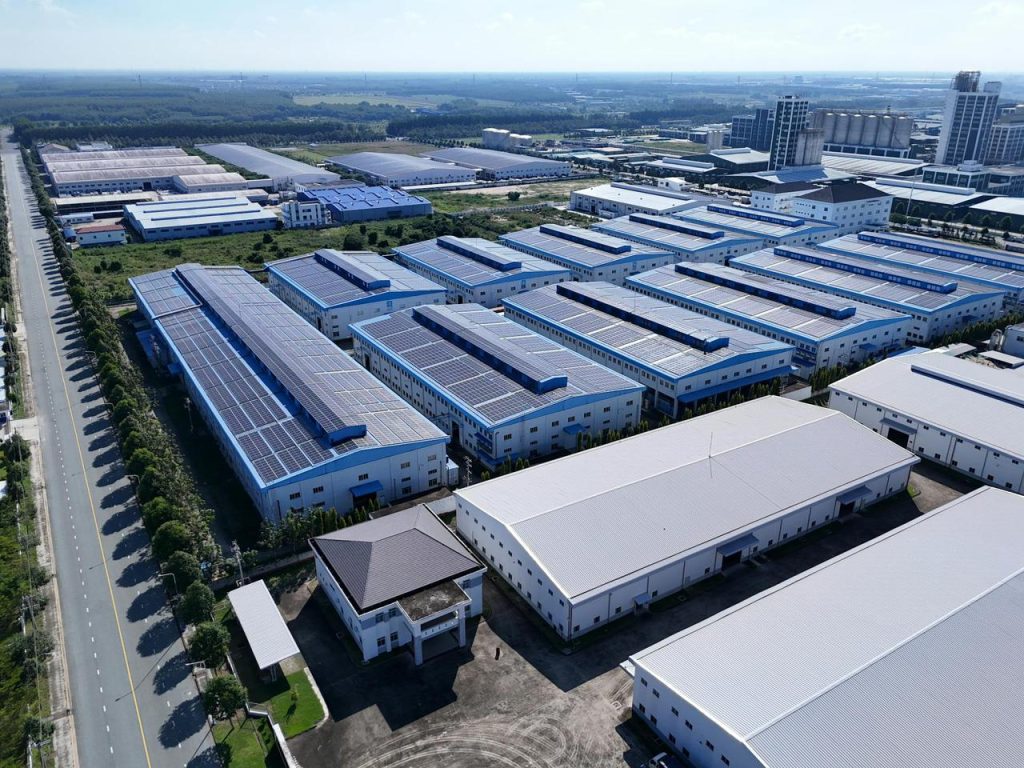
• Energy Independence: Reducing grid reliance by 60-80% during peak production hours.
• Predictable Levelized Cost (LCOE): By locking in energy costs for 25 years, manufacturers can price their products more competitively in the UK and US markets, unaffected by local energy spikes.
• Green Finance: In 2026, solar adoption unlocks lower-interest “Green Loans,” providing the liquidity needed for industrial expansion.
4. The Economics of Automation: When AI Meets Solar
The true “magic” happens when these two systems communicate via Demand-Side Management (DSM). This is a core focus of my digital consulting work.
Imagine an AI system that monitors your factory’s real-time solar yield. If the AI detects a cloud bank or a dip in battery storage, it automatically slows non-critical packaging lines to match available power.
• 9.7% Extra Savings: AI-optimized smart grids outperform “dumb” solar setups significantly.
• Grid Revenue: In net-metering markets, the AI can choose to sell excess power during peak hours, turning your factory into a revenue-generating power plant.
Maximizing Profitability Through Smart Grid Integration
Beyond simple monitoring, Smart Grid Integration allows a factory to transform from a passive energy consumer into an active asset. By using predictive algorithms, the AI can forecast energy yield and adjust heavy-load operations accordingly.
• Peak Shaving: The AI identifies when the local grid charges the highest rates and switches the factory to stored solar battery power, saving thousands in “demand charges.”
• Load Balancing: For intensive machinery like puff corn extruders, the AI “smooths” the energy flow, preventing equipment wear and tear caused by voltage fluctuations.
5. Overcoming the Barrier: The Apex Vertex Global Modular Path
The biggest myth I encounter as a consultant is that automation requires millions in upfront capital. My philosophy is different: Start Small, Scale Smart.
1. Pilot Phase: Install AI sensors on your most critical asset (like a Kurkure extruder).
2. Scale Phase: Reinvest the 12% waste savings into your first 100kW of solar.
3. Global Scale: Standardize these digital twins across multiple sites, bridging the gap between local production and international standards.
Is Your Factory Ready for the Economics of Automation?
Before diving into a full-scale overhaul, use this checklist to audit your current operations:
• Energy Baseline: Do you have a 12-month record of peak energy usage times?
• Sensor Compatibility: Does your existing machinery (e.g., your snack extruders or packaging units) have ports for IoT data sensors?
• Roof Integrity: Is your factory roof structurally sound for a high-efficiency solar array?
• Data Connectivity: Do you have a stable, high-speed internet connection on the factory floor to support real-time AI cloud syncing?
• Local Incentives: Have you researched the latest “Green Energy” tax credits available for manufacturers in your specific region?
6. Conclusion: A Strategic Bridge to 2026
The data is undeniable: 70% of manufacturers who embrace the economics of automation achieve ROI in under a year. Those who ignore these shifts risk being squeezed out by competitors who produce at a 45% lower operational cost.
I founded Apex Vertex Global to act as a strategic bridge. We are taking the automation standards of the US and UK and making them actionable for entrepreneurs in every market. Automation is more than a tech upgrade—it is the financial backbone of the modern industrialist.
Frequently Asked Questions about the Economics of Automation
How long does it take to see a return on investment (ROI)?
Typically, our clients at Apex Vertex Global see a full ROI within 12 to 18 months. This is achieved through a combination of reduced energy bills, lower waste, and the elimination of unplanned downtime.
Can I start with solar without the AI component?
Yes, but you will miss out on approximately 10-15% of potential energy savings. AI act as the “brain” that tells your solar “muscles” exactly when and where to send power for maximum profit.
Is this only for large-scale factories?
Not at all. One of the core tenets of the economics of automation is scalability. Small-to-medium enterprises (SMEs) in hubs like Dera Ismail Khan can start with modular systems and expand as their savings grow.
The Economics of Automation Glossary
• CapEx (Capital Expenditure): The initial investment in your machinery or solar panels.
• OpEx (Operational Expenditure): The day-to-day costs of running your business. Automation is designed to slash OpEx.
• Predictive Maintenance: Using data to fix a machine before it breaks.
• Net Metering: Selling your extra solar power back to the grid for credit.